


Over the last few articles, we’ve explored why so many WordPress product businesses struggle to grow beyond their initial success.
Marketplace commissions reduce margins, third-party platforms limit your ability to build customer relationships, launch momentum eventually fades, and shipping more features rarely solves a marketing problem. If you’ve recognized your own business in those challenges, you might be wondering: Where do you start?
For many technical founders, that’s where things become overwhelming. The good news is that sustainable growth doesn’t require mastering every marketing channel. It starts with building a simple, reliable foundation.
In this article, we’ll walk through the essential building blocks every WordPress product business should have before investing in more advanced strategies.
Why Most Marketing Advice Doesn’t Work for WordPress Product Businesses
Once founders realize they need marketing, they often run into a different problem: too much advice. One article tells you to invest in SEO. Another insists you should start a YouTube channel. Others recommend paid ads, daily posts on X, LinkedIn, or building a community from day one.
None of these approaches is inherently wrong. The problem is that they’re usually presented as standalone solutions, without considering how WordPress product businesses actually grow.
A WordPress plugin or theme business has different dynamics than a typical SaaS startup. Buyers often discover products while researching a specific problem, comparing alternatives, or looking for implementation guidance. That means your website, product messaging, educational content, email list, and search visibility all play different but connected roles in helping someone become a customer.
The businesses that achieve steady, long-term growth rarely ever rely on a single channel. Instead, they build a collection of marketing assets that reinforce one another over time. So, before experimenting with new marketing tactics, focus on creating that foundation.
WordPress Product Marketing Starter Kit
The following seven building blocks form a practical marketing foundation that helps WordPress product businesses generate consistent demand and create sustainable, long-term growth.
#1. A Website That Converts Visitors
Many WordPress product businesses already have a website, but not every website is designed to support growth.
For marketplace sellers especially, it’s common for the site to function as little more than a company profile, a documentation hub, or a place to redirect visitors back to the marketplace listing.
So, what should you have on your website?
Your website should be your primary marketing asset. Unlike a marketplace, it’s a space you fully control, allowing you to shape your messaging, build trust, and guide visitors toward becoming customers.
Homepage and Product Pages
Start with your homepage and product pages. Within a few seconds, visitors should understand who the product is for, what problem it solves, and why it’s worth considering. Clear positioning above the fold, straightforward pricing, well-organized feature explanations, and strong calls-to-action all help reduce friction.
Supporting Pages
Don’t overlook the supporting pages either. Comprehensive documentation, frequently asked questions (FAQs), customer testimonials, case studies, and comparison pages answer common objections before prospects have to ask. These resources also demonstrate credibility and make evaluating your product easier.
Ultimately, your website shouldn’t simply showcase your plugin or theme (read: a list of product features + a few screenshots). Its job is to convert interest into action, whether that’s downloading the free version of the plugin, trying out the product demo, signing up for your email newsletter, or making a purchase. Every page should move visitors one step closer to becoming long-term customers.
#2. Clear Positioning Before More Features
When growth slows, many founders assume the answer is to build more features. In reality, the problem is often that potential customers don’t immediately understand what the product does or why it matters to them.
Clear positioning is about communicating value, not listing features and capabilities. Technical buyers certainly care about features, but only after they’ve decided your product can solve their problem.
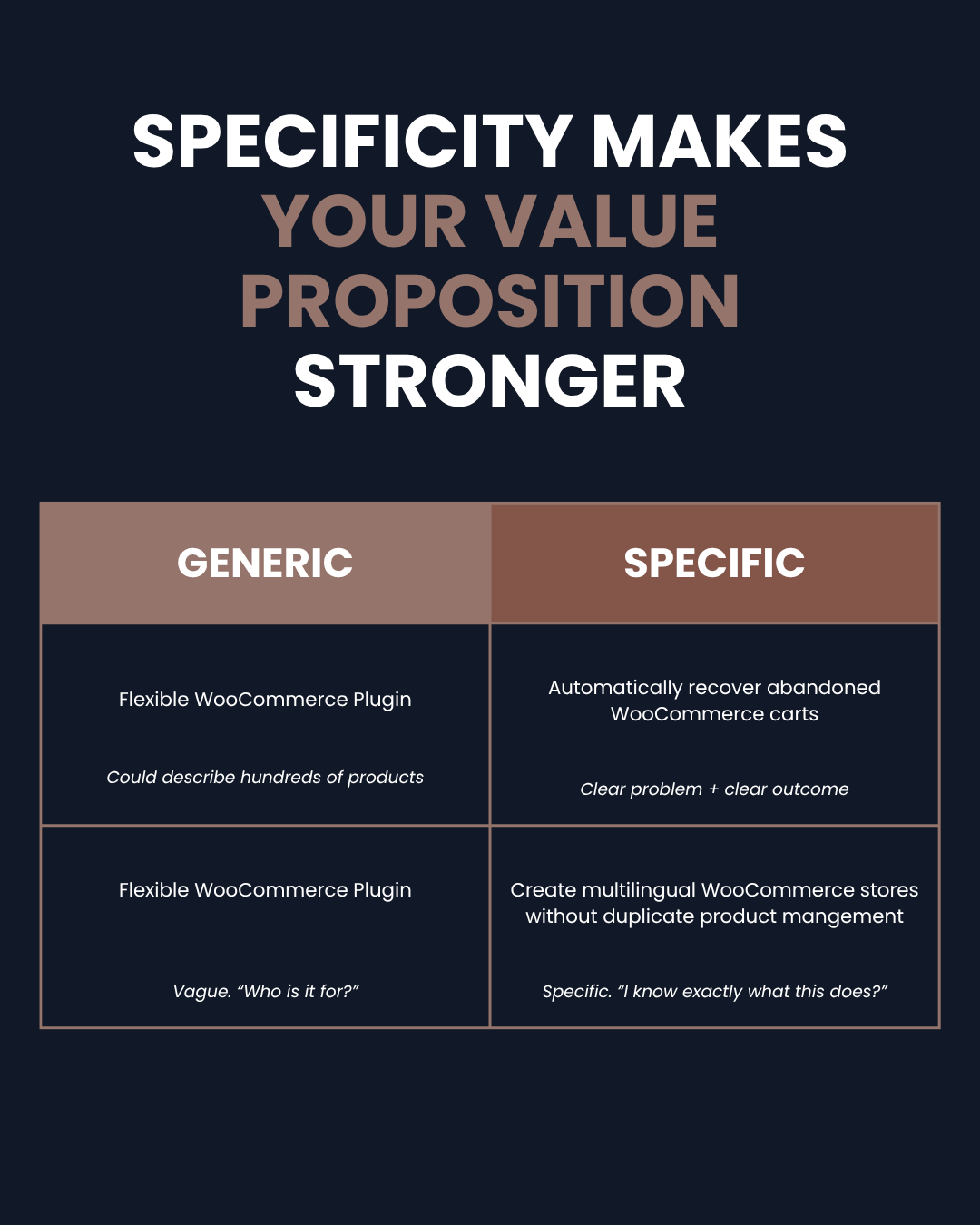
Your messaging should answer three questions within seconds:
- Who is this for?
- What problem does it solve?
- Why is it a better choice than the alternatives?
This is where specificity matters. A headline like “Flexible WooCommerce Plugin” could describe hundreds of products. Compare that with “Automatically recover abandoned WooCommerce carts” or “Create multilingual WooCommerce stores without duplicate product management”. The second examples immediately communicate a clear outcome and attract the right audience.
Strong positioning also helps you avoid competing on price alone. When visitors understand the specific problem you solve, they’re comparing solutions rather than feature checklists.
Before planning your next major release, review your website, product pages, and marketplace listings. If your messaging is vague, improving how you describe your product may have a greater impact on conversions than adding another feature.
Remember: customers buy solutions to problems, not long lists of features.
#3. Build an Email List You Own
One of the biggest lessons from the earlier articles in this series is that relying entirely on marketplaces means relying on someone else’s audience. While marketplaces are excellent for reaching buyers, they rarely help you build direct, long-term relationships with them. That’s why every WordPress product business should make growing an email list a priority.
An email list is one of the few marketing assets you truly own. It gives you a direct way to communicate with people who have shown genuine interest in your product, without depending on marketplace algorithms or third-party platforms.
There are many natural ways to encourage subscriptions. For example, you can offer a useful free tool, publish educational resources, create a practical guide, invite visitors to receive product updates, or send a newsletter that shares WordPress tips and implementation advice. The goal isn’t to collect as many email addresses as possible, but to attract the right audience.
Just as importantly, treat email as a relationship rather than a promotional channel. Share tutorials, announce new features, explain best practices, and help subscribers get more value from your product. Consistently providing useful information builds trust over time.
When you eventually launch a new feature, release another plugin, or run a promotion, you’ll already have an engaged audience that’s familiar with your brand instead of starting from zero each time.
#4. Create Content That Solves Customer Problems
Most customers don’t begin their journey by searching for your plugin or theme. They start by searching for answers. They want to solve a problem, compare approaches, troubleshoot an issue, or learn how to accomplish something in WordPress. That’s where content marketing becomes one of your most valuable long-term assets.
Instead of writing primarily about your company or product updates, create content that addresses the questions your ideal customers are already asking. Practical tutorials, implementation guides, comparisons, troubleshooting articles, best practices, and real-world use cases help potential customers long before they’re ready to buy. By consistently solving problems, you position your business as a trusted resource rather than just another software vendor.
This approach also creates opportunities for people to discover your product naturally. A developer who finds your guide on ”improving WooCommerce checkout performance” or a site owner researching ”multilingual plugins” may not know your brand today, but useful content gives them a reason to trust it tomorrow.
Content works best as part of a broader marketing system. High-quality articles strengthen your SEO, help you build topical authority, provide valuable resources to share with your email subscribers, support your social media efforts, and answer questions that would otherwise consume your support team.
Every helpful publication continues working long after it’s published, making it an investment that compounds over time.
#5. Basic SEO That Helps Content Get Found
SEO is often presented as a shortcut to growth, but that’s not how it works. Search engines can’t create demand for a product. All they do is help people discover the useful content and resources you’ve already created. That’s why SEO should support your content strategy, not replace it.
A good starting point is understanding what your potential customers are actually searching for. Focus on the problems they want to solve, the questions they ask, and the comparisons they make before choosing a plugin or theme. Those insights should guide all of your communications whether they’re blog posts, guides, docs, FAQs, or product pages.
From there, make it easy for search engines to understand your website. Use descriptive page titles, organize content around clear topics, link related articles together, and keep your documentation and product pages up to date. Pay attention to technical fundamentals like site speed, mobile usability, and crawlability, as these influence both search visibility and the user experience.
Most importantly, align every page with search intent. Someone looking for a tutorial expects practical guidance, while someone searching for alternatives is likely comparing solutions. Matching your content to what users are trying to accomplish creates a better experience and improves your chances of being found.
You can think of SEO as the distribution system for your expertise. The better your content answers real questions, the easier it becomes for the right audience to discover it.
#6. Measure What Matters
Many WordPress product founders pay close attention to downloads, sales, or marketplace rankings. While those numbers are important, they only tell you what has already happened. To improve your marketing, you also need to understand what leads people to become customers in the first place.
Start by tracking a handful of meaningful metrics rather than trying to measure everything. Here’s a quick list to help you get started:
- Organic traffic shows whether your content is attracting visitors.
- Email subscriber growth indicates whether you’re building an audience you own.
- Free trial signups, demo requests, and conversion rates reveal how effectively your website turns interest into action.
It’s equally important to know where customers come from, whether that’s search, referrals, social media, your email list, or another channel.
These insights help you make better decisions. If a tutorial consistently attracts qualified visitors, you can create more content on similar topics. If plenty of people visit your pricing page but few convert, your messaging or offer may need improvement. Instead of guessing what works, you can invest your time where it has the greatest impact.
The goal is to use analytics to replace assumptions with evidence. When you understand how customers discover, evaluate, and purchase your product, every marketing decision becomes more informed and more effective.
#7. Think Like a System (Not a Checklist)
It’s easy to think of marketing as a checklist: build a website, write a few blog posts, start an email newsletter, improve SEO, and move on to the next task. In reality, the greatest results come when these pieces work together as a connected system.
For example, a helpful article can attract visitors through search, direct them to a well-positioned product page, encourage them to join your email list, and eventually lead to a purchase. Customer questions and feedback then inspire new content, which strengthens your SEO and gives you more valuable resources to share with subscribers. Each component reinforces the others, creating momentum over time.
This is why sustainable growth rarely ever comes from a single channel. Content without SEO is harder to discover. SEO without quality content has little to promote. A great website without an email strategy misses opportunities to build lasting relationships.
So, instead of chasing the latest marketing tactic, focus on strengthening the overall system. As each part improves, the entire marketing engine becomes more effective. That’s how WordPress product businesses build predictable, compounding growth instead of relying on occasional spikes in marketplace traffic.
Conclusion
Building a successful marketing system doesn’t happen overnight, and it doesn’t need to. Start by strengthening the fundamentals: improve your website, clarify your positioning, begin growing an email list, publish genuinely helpful content, apply basic SEO best practices, and measure the results that matter. Each step makes the next one more effective.
The WordPress product businesses that achieve sustainable growth are the ones that consistently attract, educate, and convert the right customers through marketing assets they own.
With this foundation in place, you’re no longer relying solely on marketplace traffic or launch-day momentum. Instead, you’re building a system that creates demand over time and becomes stronger with every improvement.


Leave A Comment